I’m starting something I’ve wanted to do for a while.
A public, working series — from the very first line of agentic AI code all the way to an enterprise-grade architecture. No hand-waving. No “here’s the theory.” Every step is a working proof of concept you can clone, run, and break.
This is just Day 1 more yet to come.
Why now? Why Laravel?
I’ll be honest — I expected to hit walls. “PHP isn’t the AI language.” I’ve heard it. But working through this convinced me that the framework matters more than the runtime for application-layer AI work.
I’ve been building AI features for a while now — working with Python microservices, LangChain pipelines, and FastAPI wrappers around OpenAI. It’s the classic stack and it works well. But along the way, I kept running into the same gap: most learning resources either stop at simple “hello world” prompt examples or jump straight to high-level architecture diagrams without showing the practical code in between.
So I decided to approach it differently. I’m building the entire journey in Laravel, starting from scratch and sharing it publicly — one working proof of concept at a time — to show the practical steps between experimentation and real architecture.
And because it’s all Laravel — Eloquent, queues, policies, Livewire — you bring every pattern you already know. Nothing new to learn except the AI primitives themselves.
MCP registration is a route. Mcp::web('handle', ServerClass::class). Tool classes have typed properties and a handle() method. The protocol negotiation happens for you. I built a full weather server with live geocoding in under an hour.
RemembersConversations persists every agent turn to the database automatically. One trait. No Redis, no session management, no custom middleware. Resuming a conversation is $agent->continue($id, $user).
The series: Scratch to Enterprise Agentic Architecture
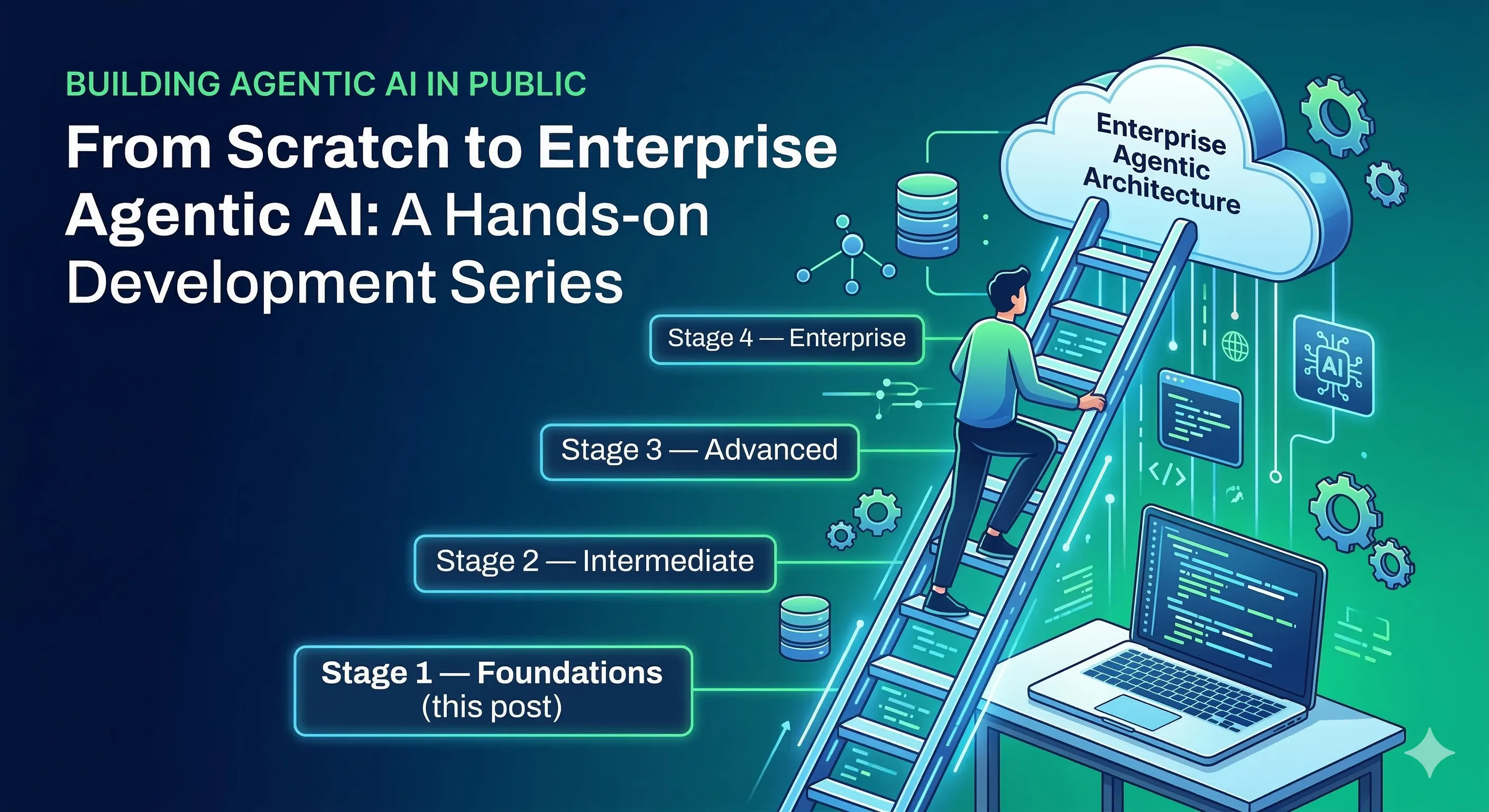
Here’s the roadmap I’m working through. Each stage gets its own working codebase, its own repo, and a post explaining what changed and why.
Stage 1 — Foundations (this post)
  ↳ What is RAG? How does retrieval actually work?
  ↳ What is an AI agent vs a prompt?
  ↳ What is MCP and why does it matter?
  ↳ Conversation memory from scratch

Stage 2 — Intermediate (coming soon)
  ↳ Multi-agent orchestration
  ↳ Tool use and function calling
  ↳ Production retrieval with Typesense / vector databases
  ↳ Async agent jobs and queues
  ↳ Agent observability and logging

Stage 3 — Advanced (coming soon)
  ↳ Agent-to-agent communication
  ↳ Planner / executor / critic patterns
  ↳ Human-in-the-loop approval flows
  ↳ Fine-tuning and model routing strategies

Stage 4 — Enterprise (coming soon)
  ↳ Multi-tenant agent architecture
  ↳ RBAC over agent capabilities and tools
  ↳ Audit trails, compliance, and PII handling
  ↳ Cost control and rate limiting across providers
  ↳ Enterprise MCP — secure, scoped, monitored
  ↳ Production deployment patterns
Advanced and enterprise stages are being actively architected. I’ll share them as working demonstrations, not just diagrams — you’ll be able to run every stage locally.
Stage 1: What I built
To kick this off I built a Laravel POC covering the foundations of agentic development. Open source, intentionally transparent — every line is written to be read.
→ RAG from scratch — A pure-PHP TF-IDF retrieval implementation so you can see exactly what happens before reaching for a vector database. Tokenization, IDF weighting, cosine similarity — all in one readable service class.
→ RAG + Laravel AI Agent — The same retrieval pipeline wired into a proper Agent class. Retrieved documents get injected into system instructions at runtime. The LLM only knows what you give it.
→ Multi-turn RAG Chat — A conversational interface where the agent retrieves fresh context per message, maintains full history, and uses its own reasoning to stay on topic — not a hardcoded gate.
→ MCP Server — A live Model Context Protocol server with tools, resources, and prompts. Register it once and Claude Desktop, Cursor, or VS Code connects immediately. No glue code.
The first lesson: stop gatekeeping with code
The temptation in agentic development is to build elaborate rule-based logic around your LLMs. “If retrieval score is below 0.1, reject the query.” I did exactly this at first.
That’s backwards.
The LLM is the reasoning layer. It handles follow-up questions, paraphrasing, context from prior turns. A similarity threshold cannot. What you need is a strict, well-crafted system prompt that defines what the model is allowed to know and what to say when it doesn’t know something. Let the model decide. Trust the reasoning — just constrain the knowledge.
That’s the first real principle of agentic design. Every stage of this series builds on it.
Stage 2 is already in progress.
If you want to follow along — working code, real architecture decisions, honest writeups about what didn’t work — this is the series. Repo link https://github.com/rupeshstha/ai-poc?tab=readme-ov-file#getting-started. Star it if you want to track progress.